
01
Battery State of Health (SOH)
How much usable capacity the pack retains compared with when it was new. Shown as the vehicle-reported figure when the BMS exposes it; otherwise any estimate is clearly labelled as derived.
BMSDerived
Independent EV battery diagnostics in India
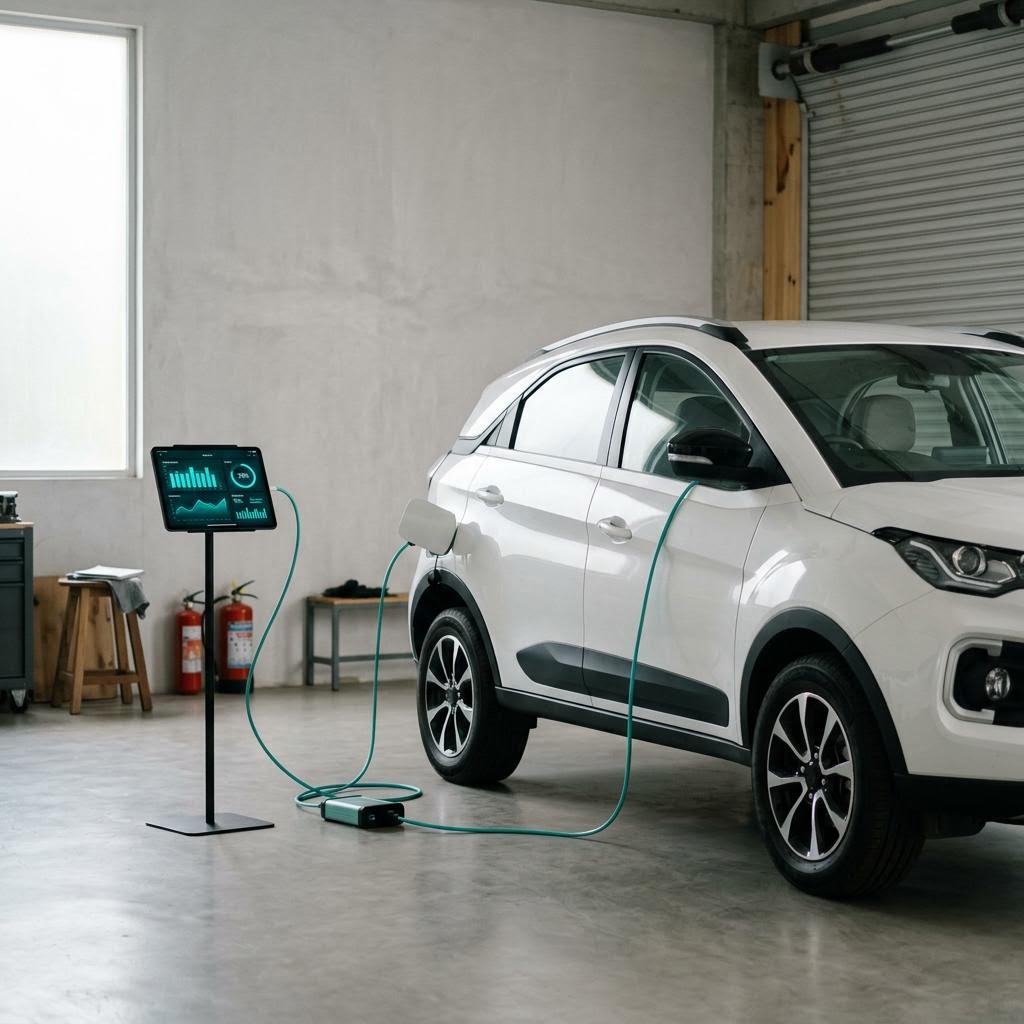
A non-invasive assessment of your electric car battery and other accessible electronic control units (ECUs) through the vehicle diagnostic interface, without opening the battery pack. Exterior, drive, service-history and Vahan checks belong to our comprehensive EV inspection.
What EV battery health means
Battery health is about how the pack has aged, not how full it is today. These four terms describe different things, and no single one tells the whole story.
SOH
Long-term condition. How much capacity the battery still holds versus new. Changes slowly over months and years.
SOC
Short-term level. How full the battery is right now, as a percentage. Changes every time you drive or charge.
SOE
Usable energy remaining in kWh at this moment. Related to SOC, but it also reflects voltage and temperature.
SOP
How much power the battery can safely deliver or accept right now. Cold, heat, low charge or faults can reduce it.
What we look at
Battery indicators and accessible ECU readings, reviewed together. We separate what the vehicle reports directly from what we estimate.
How much usable capacity the pack retains compared with when it was new. Shown as the vehicle-reported figure when the BMS exposes it; otherwise any estimate is clearly labelled as derived.
The vehicle’s estimate of how full the battery is right now, like a fuel gauge. It is not a measure of how much capacity the pack has retained over time.
The spread between the highest- and lowest-voltage cell groups. A wide or growing gap can point to uneven ageing or a weak group.
Pack temperature sensor readings, and how they move at rest, while driving or charging, where those channels are available.
Stored and pending battery-management and high-voltage diagnostic codes, explained in plain language with their limits.
Pack voltage and current at rest and under demand show how the battery responds when asked for energy.
Signs that the vehicle is limiting power or regen because of battery condition, temperature or a fault, where limits are reported.
What the readings do during a controlled drive or charge session, when conditions allow one to be carried out safely.
Diagnostic coverage depends on the vehicle. Not every EV exposes every parameter listed above, and some data may only be available through manufacturer tools. Readings from other accessible ECUs are included where available. We will tell you what can and cannot be read for your vehicle before and during the assessment.
In more detail
The battery management system (BMS) monitors the pack and stores readings and fault codes. We read what the vehicle exposes through its diagnostic port. Some EVs share a lot, some very little, and some data is only available through manufacturer tools. We tell you what was and was not accessible.
A pack is made of many cells grouped in series. If one group drifts lower than the others, the BMS may stop discharging early or charge more slowly to protect it, reducing usable range and power. A small spread is normal; a wide or unusual one deserves attention.
Together these show how the pack responds to demand. Voltage that sags sharply under load, or temperatures that differ widely between sensors, can point to ageing or cooling issues worth investigating.
Stored and pending codes from the BMS and high-voltage systems reveal history a test drive cannot, including intermittent faults. A code is a clue, not a verdict; we explain what it may mean and what it does not prove.
Where safe and practical, readings during acceleration or regeneration show whether the vehicle is limiting power, which can signal temperature, charge-level or battery-condition constraints.
Resting readings show balance without load, driving shows response to demand, and charging shows how the pack accepts energy. Which of these we can carry out depends on the vehicle, its charge level and conditions on the day.
SOH methods differ between manufacturers. Cell spread depends on charge level and temperature at the time. Codes may be historic. Range depends on conditions. That is why we interpret readings together and state their limits, rather than reducing a battery to one score.
A simple scan lists stored fault codes. A battery assessment also reviews SOH where available, cell balance, temperatures, voltage and current behaviour, and puts them in context with the codes, ending in a written report with suggested next steps.
What you receive
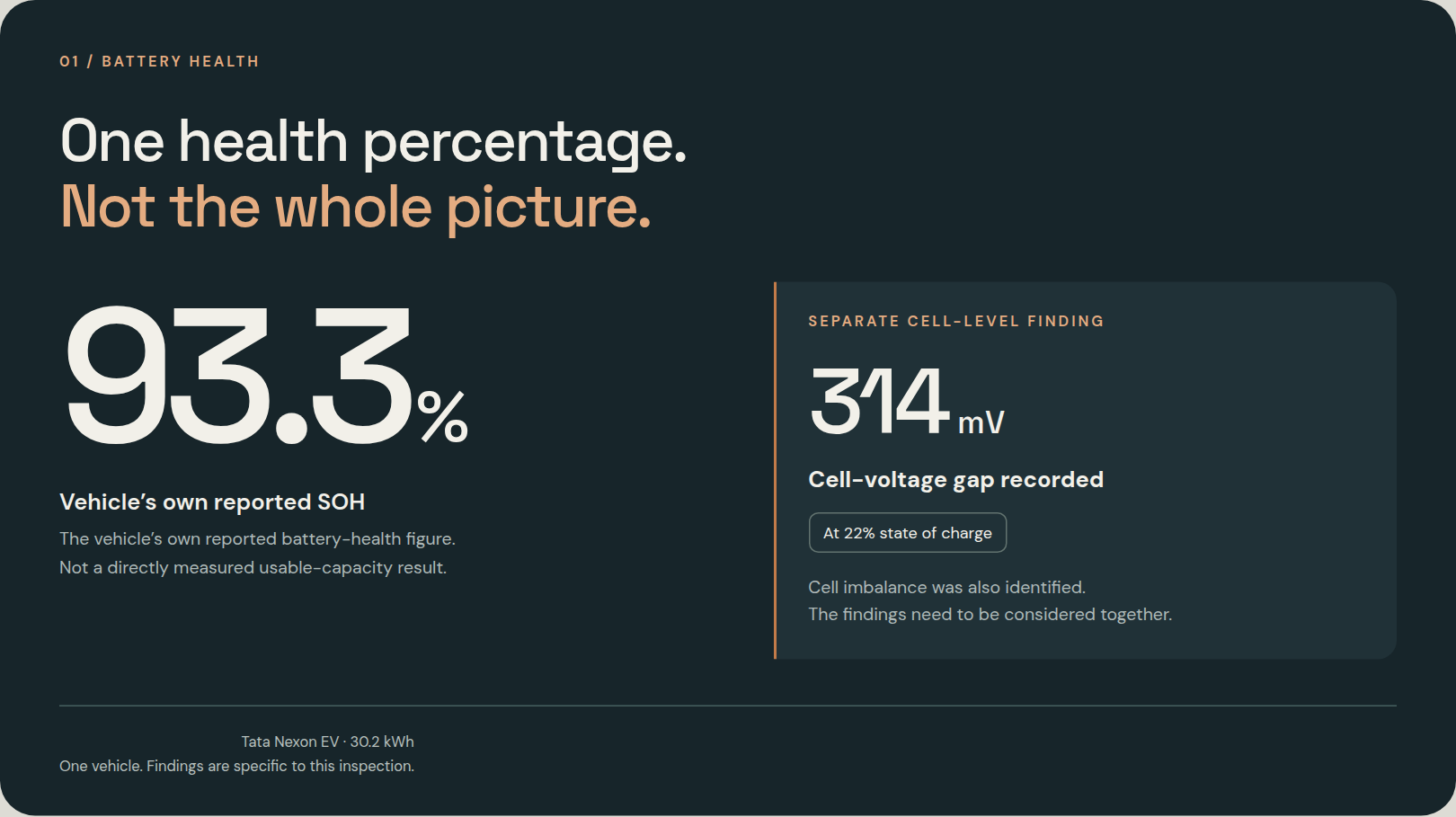
These excerpts come from one inspected Tata Nexon EV. They show battery and accessible ECU findings; values and diagnostic coverage vary by vehicle. A digital report may include:
Battery SOH, when accessible
The vehicle-reported figure, shown separately from any derived estimate.
Cell voltage variation
Highest and lowest cell-group voltages and the gap between them.
Temperature observations
Returned sensor channels, plus any that need verification.
Diagnostic trouble codes
Stored and pending codes with plain-language context.
Performance findings
Behaviour seen during the checks that conditions allowed.
Detected abnormalities
Anything outside expected patterns, stated with its limits.
Recommendations
Suggested next steps, including when further workshop inspection is advisable.
Test eligibility
We are building model-by-model evidence. Until a model is validated across its variants, it stays under evaluation.
FAQ
Booking options
Share a few details. We will call to confirm whether your vehicle is supported, explain what can be read, and arrange a suitable time.
Your name, phone number, state, city, vehicle make, model, variant, year of manufacture and consent are required. Only battery capacity and message are optional. Submitting this form sends an enquiry; it does not confirm an appointment.